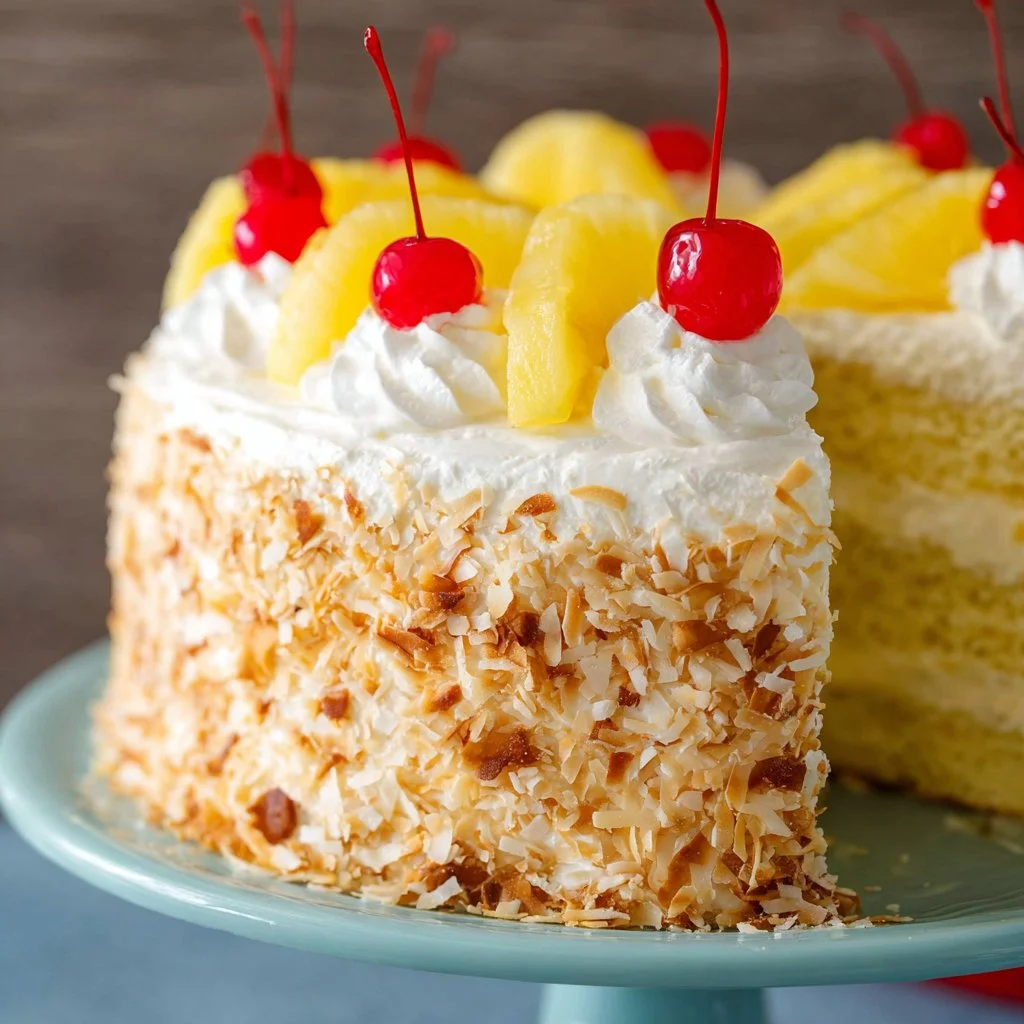
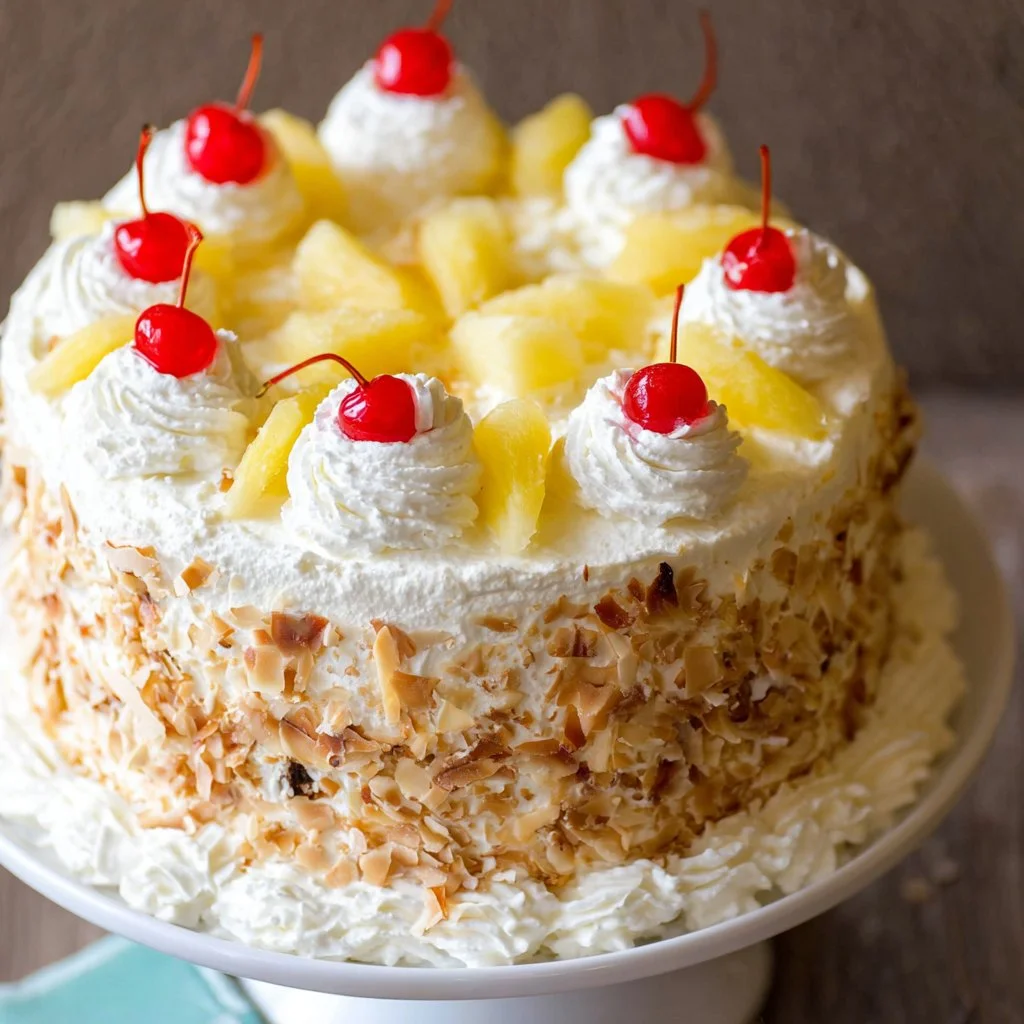
Pina Colada Layer Cake, can I be honest with you for a moment? When I first baked this, I was craving something bright, comforting, and a little nostalgic, and this cake delivered exactly that. Imagine layers of tender coconut-scented cake nestled around a warm, jammy pineapple filling and coated in silky coconut buttercream topped with toasted coconut, cherries, and slices of fresh pineapple. I made it for a backyard spring gathering and watched smiles spread with every slice. If you love sunny, crowd-pleasing desserts like my lemon blueberry layer cake, this one will quickly become a new favorite.
Why You’ll Love This Recipe
- Quick and easy to prepare when you follow the steps
- Uses simple, pantry-friendly ingredients you likely have on hand
- Perfect for spring, summer, or any tropical-themed celebration
- Comforting and impressive enough to serve guests or make for family gatherings
What sets this version apart is the balance between the tender, lightly coconut-scented cake layers and the slightly tangy pineapple filling that is cooked until jammy. The coconut buttercream both anchors the flavors and gives structure for piping and toasting. I chose a mix of butter and shortening in the frosting to make it stable for decorating and toasting, especially in warm kitchens. This is the kind of cake that makes you feel confident in the kitchen because the steps are forgiving and the results are reliably joyful.
Core Ingredients at a Glance
Ingredients Needed
Pineapple Filling
- 2/3 cup (138 g) granulated sugar
- 3 tablespoons cornstarch
- 16 ounces crushed pineapple, including the juice (canned is fine; use fresh crushed if you prefer a fresher taste)
- 2/3 cup (160 ml) water
- 1/4 teaspoon vanilla extract
Cake Layers
- 3/4 cup (168 g) unsalted butter, softened to room temperature
- 1 1/2 cups (310 g) granulated sugar
- 3/4 cup (173 g) sour cream, at room temperature (adds tenderness; Greek yogurt is a possible substitute but may alter flavor slightly)
- 1 tablespoon coconut extract (for that unmistakable tropical aroma)
- 6 large egg whites, room temperature (these help create a lighter crumb)
- 2 1/2 cups (325 g) all-purpose flour, spooned and leveled
- 4 teaspoons baking powder
- 1/2 teaspoon fine salt
- 3/4 cup (180 ml) milk, room temperature
- 1/4 cup (60 ml) water, room temperature
Coconut Buttercream Frosting
- 1 1/4 cups (280 g) unsalted butter, softened
- 1 1/4 cups (237 g) vegetable shortening, softened (helps stabilize the frosting for piping and warm conditions)
- 10 cups (1150 g) powdered sugar, sifted for a smooth finish
- 1 1/2 tablespoons coconut extract
- 6 to 7 tablespoons (90-105 ml) water or milk, as needed to reach spreading consistency
Toppings and Garnish
- 2 cups (153 g) sweetened coconut flakes, toasted for added crunch and color
- Maraschino cherries or fresh cherries for decoration
- Sliced pineapple, drained, for garnish
Ingredient Clarifications and Substitutions
- Crushed pineapple: canned with juice is written into the recipe to create the filling. Fresh crushed pineapple can be used but drain lightly and add a bit more water if needed.
- Coconut extract: this gives a strong coconut flavor without using alcohol. If you want a subtler flavor, reduce to 2 teaspoons.
- Butter and shortening in frosting: this combo makes buttercream easier to pipe and slightly more heat resistant. You can use all butter for richer flavor but the frosting will be softer at room temperature.
- Egg whites only: this helps the cake rise with a tender, delicate crumb and avoids a dense feel. If you prefer whole eggs, know the texture will be slightly richer and denser.
- Sour cream: swap for full-fat plain yogurt, but sour cream provides the best tender crumb and tang balance.
Ingredients & Equipment Notes (Optional)
- Mixing bowls: Have a large bowl for creaming and a separate bowl for dry ingredients to ensure even distribution of leaveners.
- Stand mixer or hand mixer: A stand mixer with paddle attachment makes creaming and frosting easier, but a hand mixer works fine.
- Three 8-inch cake pans: Line with parchment circles and grease the sides to remove layers cleanly.
- Cooling racks: Essential for cooling layers so condensation does not make the cake soggy.
- Offset spatula and bench scraper: For smooth frosting and clean sides.
- Serrated knife or cake leveler: To remove domes from cake layers for even stacking.
- Piping bag and tip (optional): For piping dams and decorative swirls. I used a medium star tip for top swirls.
- Oven thermometer: Helpful to verify your oven is at the correct 350 F. Accurate temperature helps bake evenly.
- Baking sheet and parchment: For toasting coconut flakes.
If you enjoy experimenting with textures and frostings, check how the balance of butter to shortening affects piping in my note on stable frostings in similar recipes like the Biscoff cookie butter cake.
Instructions – How to Make “Pina Colada Layer Cake”
- Prepare pans and preheat the oven: Preheat your oven to 350 F (176 C). Grease the sides of three 8-inch cake pans and line the bottoms with parchment circles. This ensures cakes release easily and keep perfect round shapes.
- Why this matters: Greasing and parchment prevents sticking and makes stacking cleaner.
- Visual cue: The parchment will sit flat in the pan and batter will barely adhere to the sides.
- Make the pineapple filling – mix dry ingredients: In a medium-large saucepan, combine 2/3 cup granulated sugar and 3 tablespoons cornstarch. Whisk them together to remove lumps.
- Why: The cornstarch needs to be evenly dispersed to thicken the filling uniformly.
- Add pineapple and water: Stir in the entire 16 ounces crushed pineapple, including the juice, plus 2/3 cup water. Mix well so the cornstarch is fully hydrated.
- Mini tip: If you prefer a chunkier filling, use less stirring; for a jam-like smoothness, mash gently with a spoon.
- Cook until thickened: Place the saucepan over medium-high heat. Stir regularly as the mixture warms. It will begin to bubble and thicken in about 8 to 10 minutes. Once it reaches a boil, continue cooking for 1 1/2 minutes while stirring constantly to remove the starchy taste.
- Visual cue: The mixture will transform from watery to glossy and slightly translucent as it thickens.
- Why this step matters: Boiling ensures the cornstarch fully activates so the filling sets when cool.
- Finish the filling: Remove the pan from heat and stir in 1/4 teaspoon vanilla extract. Let it cool completely at room temperature, then transfer to the refrigerator if you want it chilled and jammy before assembling.
- Mini tip: Spread the filling thin on a plate to speed cooling if you are in a hurry.
- Start the cake batter – cream butter and sugar: In a large mixing bowl or the bowl of a stand mixer fitted with the paddle, cream together 3/4 cup (168 g) unsalted butter and 1 1/2 cups (310 g) granulated sugar for about 3 to 4 minutes until light in color and fluffy. Do not rush this step.
- Why this matters: Proper creaming incorporates air for lift and helps sugar dissolve into the butter for a tender crumb.
- Visual cue: The butter will look paler and the mixture will be airy and smooth.
- Add sour cream and coconut extract: Mix in 3/4 cup sour cream and 1 tablespoon coconut extract until evenly combined. Scrape down the bowl so everything blends smoothly.
- Mini tip: If your sour cream is cold it can seize the butter. Ensure both are at room temperature.
- Add egg whites in batches: Add the 6 large egg whites in two additions, mixing until each addition is well incorporated. Scrape the bowl sides to ensure an even batter.
- Why: Adding whites gradually stabilizes the emulsion and maintains volume.
- Combine dry ingredients: In a separate bowl, whisk together 2 1/2 cups all-purpose flour, 4 teaspoons baking powder, and 1/2 teaspoon salt. This ensures leavening is evenly distributed.
- Mini tip: Sift if your flour is prone to clumping.
- Prepare milk and water: Combine 3/4 cup milk and 1/4 cup water together in a small measuring cup. Keep this mixture at room temperature.
- Why: Alternating dry and wet ingredients prevents overmixing and keeps the cake tender.
- Build the batter in thirds: Add half of the dry ingredients to the creamed mixture and mix until just combined. Next, pour in the milk-water mixture and mix again. Finally, add the remaining dry ingredients and mix until the batter is uniform. Scrape the bowl as needed.
- Visual cue: The batter will be smooth, slightly thick, and pourable, not stiff.
- Why this technique matters: Alternating prevents gluten overdevelopment which keeps crumb tender.
- Divide batter and bake: Evenly distribute the batter into the three prepared pans. Bake in the preheated oven for 21 to 23 minutes, or until a toothpick inserted in the center comes out with a few moist crumbs attached.
- Visual cue: Cakes will be lightly golden on top and slightly spring back when touched.
- Mini tip: Rotate pans halfway through baking if your oven has hot spots.
- Cool the layers: Remove pans from oven and let cool for 2 to 3 minutes on a wire rack. Run a knife around the pans, then invert the layers onto racks to cool completely. Do not attempt to frost while still warm.
- Why: Cooling prevents the frosting from melting and keeps layers stable.
- Make the coconut buttercream – combine fats: In a clean large mixer bowl, beat together 1 1/4 cups (280 g) unsalted butter and 1 1/4 cups (237 g) vegetable shortening until smooth and airy.
- Why: Incorporating air at this stage yields a light, pipeable buttercream.
- Add powdered sugar in two phases: Slowly add half of the 10 cups powdered sugar and beat until smooth. This keeps the sugar from flying out of the bowl and helps integrate it evenly.
- Mini tip: Use a low speed to start, then increase to medium for a few minutes.
- Flavor and thin: Mix in 1 1/2 tablespoons coconut extract and add 5 to 6 tablespoons water or milk. Beat until smooth and spreadable.
- Why: The extract brings that coconut-forward flavor; liquids adjust the consistency.
- Finish the buttercream: Add the remaining powdered sugar slowly and beat until fully smooth. Add extra water or milk, one teaspoon at a time, if you need a softer consistency for spreading or piping.
- Visual cue: Proper buttercream will be glossy, smooth, and hold a peak for piping.
- Toast the coconut: Preheat oven to 400 F (204 C). Spread the 2 cups of sweetened coconut flakes evenly on a parchment-lined baking sheet. Bake for 5 to 8 minutes, tossing every couple minutes to brown evenly. Remove when golden and fragrant.
- Mini tip: Coconut goes from golden to burnt quickly. Watch carefully in the final moments.
- Why: Toasting adds crunch and a nutty flavor that balances the sweet buttercream.
- Level the cake layers: Use a large serrated knife or cake leveler to remove any domes so each layer is flat and sits snugly on the next.
- Why: Flat surfaces prevent slippage and create neat, stable stacks.
- First layer and piping dam: Place the first cake layer on a serving plate or cake round. Pipe a shallow dam of coconut buttercream around the edge to hold the pineapple filling in the center.
- Why: The dam prevents the filling from seeping into the sides and keeps layers tidy.
- Add pineapple filling: Spoon about 1 cup of the cooled pineapple filling into the center of the first layer inside the frost dam and spread gently but leave space at the edge to avoid overflow.
- Mini tip: Do not overload; too much filling can make layers slide.
- Repeat for second layer: Place the second cake on top and again pipe a buttercream dam and add another cup of pineapple filling. You may have a small bit of filling leftover if you prefer to use less.
- Visual cue: You will see a neat sandwich of cake, frosting dam, and jammy pineapple center.
- Stack and crumb coat: Add the final layer and apply a thin crumb coat of buttercream over the entire cake to trap stray crumbs. Chill for 15 to 20 minutes to set the crumb coat.
- Why: A crumb coat makes the final frosting smooth and crumb-free.
- Final frost and decorate sides: Frost the outside of the chilled cake with the remaining buttercream, smoothing with an offset spatula and bench scraper for clean edges. Press toasted coconut into the sides of the cake gently so it adheres.
- Mini tip: If the frosting gets too soft, refrigerate for 10 minutes to firm up before final smoothing.
- Pipe swirls and garnish: Use remaining buttercream to pipe decorative swirls around the top edge. Add cherries to the swirls and tuck slices of pineapple onto the cake as a finishing touch. Chill briefly to set the decorations, then serve at room temperature for the best texture.
- Why: Chilling helps toppings stay in place but serving at room temperature maximizes flavor and creaminess.
Serving Suggestions & Storage Tips
Serving Ideas
- Slice and serve with a dollop of lightly whipped cream or a scoop of coconut or vanilla ice cream for an extra indulgent touch.
- For a brunch or dessert bar, offer fork-friendly slices with extra pineapple on the side and a small bowl of toasted coconut.
- For a kid-friendly presentation, remove the cherries or substitute with halved fresh cherries.
Presentation Tips
- Arrange sliced pineapple and toasted coconut artfully on top for a tropical centerpiece.
- Use a cake stand to elevate the cake and catch any crumbs or stray toasted coconut for a tidy display.
- Serve on chilled plates to keep each slice neat for guests.
Pairings
- Non-alcoholic pairings work best given the restrictions: a chilled iced tea with lemon, sparkling water with a splash of pineapple or coconut water, or a tropical fruit punch.
- Light, citrusy teas or coffees let the cake remain the star.
Storage
- Room temperature: If your kitchen is cool, you can leave the covered cake at room temperature for up to 24 hours.
- Refrigerator: Store leftover slices in an airtight container for up to 4 days. The frosting will firm up in the fridge; bring slices to room temperature before serving.
- Freezer: You can freeze individual slices wrapped tightly in plastic and then foil for up to 2 months. Thaw in the refrigerator overnight, then bring to room temperature before serving.
Best Reheating Methods
- Avoid microwaving the whole slice for long periods as the toasted coconut can become soggy. Instead, let frozen slices thaw in the fridge and then sit at room temperature for 30 to 60 minutes. If you want a warm bite, warm briefly on low power in 10-second increments, checking often.
If you like storing and reheating desserts, my notes on make-ahead cakes and desserts in the caramel crunch cheesecake fruit salad post offer ideas that translate well to layered cakes.
Helpful Notes & Variations
Ingredient Substitutions and Tweaks
- All-butter frosting: Replace the shortening with an extra 1 1/4 cups butter for richer flavor, but note the frosting will be softer at room temperature.
- Reduced sweetness: Use unsweetened coconut flakes toasted for the garnish and consider slightly reducing powdered sugar if you prefer a less sweet frosting.
- Dairy-free option: Use dairy-free butter and a vegan shortening, swap sour cream for coconut yogurt, and use non-dairy milk for the batter. Expect textural differences.
Dietary Adaptations
- Gluten-free: Substitute a 1-to-1 gluten-free flour blend designed for baking. Increase baking powder slightly if needed and be mindful of moisture differences with the filling.
- Lower sugar: This recipe relies on sugar for structure and texture. Reducing sugar dramatically will alter the cake’s crumb and the filling’s set. Try reducing up to 10 to 15 percent and test.
Flavor Add-ins
- Toasted macadamia nuts: Press a small amount into the top edge for crunch contrast.
- Lime zest: Add 1 to 2 teaspoons of lime zest to the pineapple filling for bright acidity that complements the coconut.
- Coconut flakes in the batter: Fold 1/2 cup lightly toasted flakes into the batter for extra texture.
Common Mistakes and How to Avoid Them
- Overmixing after adding flour: Mix only until combined to avoid a tough cake.
- Filling too runny: Ensure you boil the pineapple filling for the full 1 1/2 minutes and let it cool thoroughly so it sets.
- Frosting too soft: Chill briefly if your buttercream is too soft to pipe or smooth. Adding a touch more powdered sugar can also firm it up.
- Toasted coconut burning: Watch closely and toss often; remove a bit early as it will darken slightly as it cools.
Experience-Based Tips
- Temperatures matter: Bring eggs, butter, sour cream, and milk to room temperature for uniform mixing.
- Use a cake board: It makes transfer to serving plates easier and helps support the cake when moving.
- Make filling ahead: The pineapple filling can be made a day ahead and refrigerated. It actually benefits from the resting time as flavors meld.
Conclusion
This Pina Colada Layer Cake is a tender, tropical celebration of pineapple and coconut, designed to delight anyone who loves bright, nostalgic flavors without alcohol. The combination of a jammy pineapple filling, light coconut-scented cake layers, and stable coconut buttercream produces a showstopping dessert that stays friendly to family gatherings and warm-weather celebrations. Try making the pineapple filling ahead of time to streamline assembly and keep toasted coconut to the last minute for the best crunch. If you want inspiration for variations or original recipes that inspired this style of cake, check out the Pina Colada Layer Cake | Life Love and Sugar for additional styling ideas, explore advanced piping techniques at Pina Colada Cake – Liv for Cake, or review an extra detailed scratch recipe guide at Piña Colada Cake Recipe. Give the recipe a try, leave a comment and star rating to let me know how it turned out, and share a slice photo on Pinterest or your favorite social platform.
- Frequently Asked Questions
Can I make this recipe ahead of time?
Yes. You can prepare the pineapple filling up to 2 days ahead and refrigerate it. Bake the cake layers a day earlier and wrap them tightly. Assemble the cake on the day you plan to serve for best texture, or crumb-coat and chill overnight, then finish decorating the next day.
How should I store leftovers and how long do they last?
Store cake slices in an airtight container in the refrigerator for up to 4 days. If wrapped well and frozen, slices can last up to 2 months. Thaw in the refrigerator overnight before serving.
What is the best way to reheat or serve this recipe after storage?
For refrigerated cake, let slices sit at room temperature for 30 to 60 minutes before serving so the buttercream softens and flavor blooms. For frozen slices, thaw in the fridge overnight and then bring to room temperature. Warm briefly on low power in the microwave in 10-second bursts only if you want a warm bite.
Can I adjust or substitute ingredients to fit my preferences?
Yes. You can swap sour cream for full-fat yogurt, use all butter in the frosting for richer flavor, or choose a gluten-free flour blend. Keep in mind that substitutions can change texture and moisture, so small tests are recommended.
Do you have tips to ensure the best texture and flavor every time?
Keep ingredients at room temperature, do not overmix after adding flour, and ensure the pineapple filling is fully thickened and cooled before assembling. Toast coconut just before decorating and chill the cake briefly after a crumb coat for the smoothest finish.
Pina Colada Layer Cake
Ingredients
Method
- Preheat the oven to 350 F (176 C). Grease and line three 8-inch cake pans with parchment.
- In a medium saucepan, mix the granulated sugar and cornstarch for the pineapple filling.
- Stir in the crushed pineapple and water, and cook until thickened, about 8 to 10 minutes, then stir in the vanilla.
- In a mixing bowl, cream together butter and sugar until fluffy, then add sour cream and coconut extract.
- In batches, mix in egg whites, then combine dry ingredients in a separate bowl and add alternately with the milk and water.
- Divide the batter into the prepared pans and bake for 21 to 23 minutes. Cool for 2 to 3 minutes, then transfer to wire racks to cool completely.
- For the buttercream, beat together the butter and shortening until smooth, then gradually add powdered sugar and mix in coconut extract and liquid to reach desired consistency.
- Toast the coconut in the oven until golden brown, about 5 to 8 minutes.
- Level the cooled cake layers if necessary.
- Place the first layer on the service plate and pipe a dam of buttercream around the edges. Fill with about 1 cup of the pineapple filling.
- Repeat with the second layer, then add the final layer on top.
- Apply a crumb coat and chill for 15 to 20 minutes before frosting with the remaining buttercream.
- Decorate with toasted coconut, cherries, and fresh pineapple slices.